 |
924Board.org
Discussion Forum of 924.org
|
| View previous topic :: View next topic |
| Author |
Message |
ideola

Joined: 01 Oct 2004
Posts: 15550
Location: Spring Lake MI
|
 Posted: Fri Sep 07, 2007 8:06 pm Post subject: Posted: Fri Sep 07, 2007 8:06 pm Post subject: |
 |
|
| RC wrote: | | You have the engine apart so it is easy to get a practical understanding. |
| endwrench wrote: | | the crank is cross drilled from what I remember |
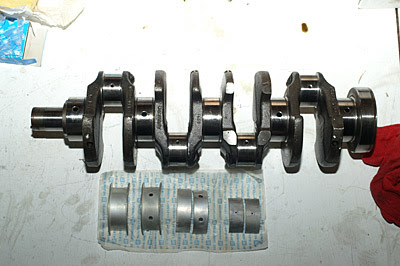
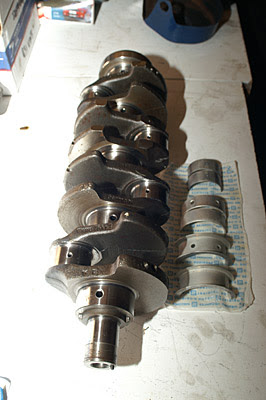
This would be a suitable juncture to post pix of the stroker crank...comin' right up...
In the meantime, this is a photoshopped picture of the actual rod depicting what the folks at Crower said would act as a squirter, denoted by the bright red mark (obviously, not that big, just an indication of where it should go). Also, in this pic, you can see the wrist pin oil pin hole at the top of the w.p. end...
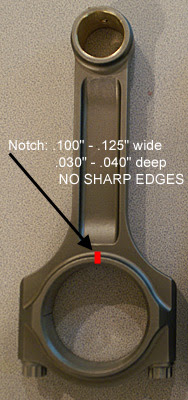
Related question...would it suffice to put only one notch, on the same side as the stock squirter? Would there be any benefit or adverse effect to putting a notch on both sides of the rod? Also, it seems that if one were to put a notch there in the rod that it would also require a matching notch in the top bearing...
_________________
erstwhile owner of just about every 924 variant ever made
Last edited by ideola on Fri Jul 17, 2009 11:47 pm; edited 1 time in total |
|
| Back to top |
|
 |
ideola
Joined: 01 Oct 2004
Posts: 15550
Location: Spring Lake MI
|
| Posted: Fri Sep 07, 2007 8:56 pm Post subject: |
|
|
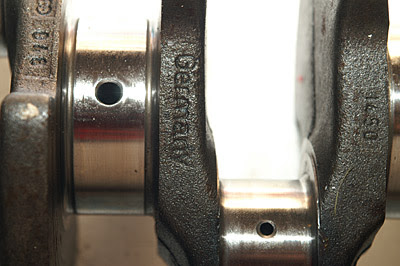
And, here are pix of the stroker crank, showing the cross-drilling referenced above, as well as closeups of the weld & regrind at a couple of the rod journals. Note also the rod and main bearings in the first couple of photos. Nick, interesting that in my set of rod bearings, all of halves have the oiling pin hole...
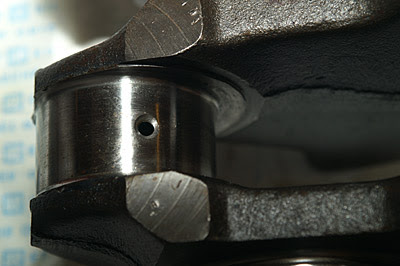 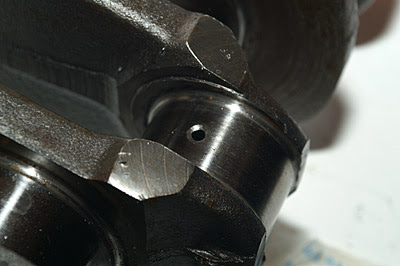
_________________
erstwhile owner of just about every 924 variant ever made
Last edited by ideola on Fri Jul 17, 2009 11:49 pm; edited 1 time in total |
|
| Back to top |
|
|
Smoothie

Joined: 01 Jan 2003
Posts: 8032
Location: DE (the one near MD, PA, NJ)
|
| Posted: Mon Sep 10, 2007 1:13 pm Post subject: |
|
|
Here's a diagram of a Fiat 124 engine showing how and where pressurized oil is delivered in an engine -


An oddball, interesting feature of that lubrication system is that it has a centrifugal oil filter in addition to the usual type.
_________________
"..it's made in Germany. You know the Germans always make good stuff."
'82 924T, US version, dark green metallic, 5 speed Audi 016G gearbox |
|
| Back to top |
|
|
ideola
Joined: 01 Oct 2004
Posts: 15550
Location: Spring Lake MI
|
| Posted: Wed Sep 12, 2007 5:58 am Post subject: |
|
|
Here's an update on my research. I took my block in to a couple of local motown speedshops today and solicited some local wisdom on the oil squirter / oil sprayer scenario.
Auxiliary Oil Sprayers
In theory, this would be an ideal upgrade for our cars. However, in practice, it would be somewhat challenging to implement, primarily because the oil galleys do not run the length of the block (they only progress as far as the oil filter mount).
As a result, there are really only two options available that meet my criteria of low cost in order to install oil sprayers (that is, you could probably rig up a complicated set of mounted sprayers with a dedicated line, yada yada. Not gonna go there).
Option 1
- Drill a vertical oil passage into the "bearing slots" that are on the number 1,2,4 & 5 main crank journals
- Drill a horizontal, tappable passage above the journal perpendicular to the new oil passage
- In this horizontal, tapped & threaded hole, insert a nozzle with check valve
- The nozzle would have to be aimed at the cylinder, and would also have to clear the crank and rod.
Option 2
- Drill a tiny hole, about .020" on an angle thru the aforementioned slot that would come out just above the main journal and would direct pressurized oil up onto the cylinder
- The problem with this approach is that without a check valve, you would encounter drain back out of the main bearing until oil pressure stabilized. Not a huge deal if you don't rev the car hard on startup, but not ideal either.
To top it off, one of the drawbacks with this type of sprayer setup that I've seen mentioned in a number of online articles is that the nozzles have a tendency to clog, or the check valves can get stuck in the open position, which has the unwanted effect of bleeding of oil pressure at low RPM.
Notched Rods to Simulate Stock Squirters
At the same time, the sources I consulted with today both made the independent and unsolicited suggestion that the rods could be notched in precisely the way Crower suggested. As further corroboration, without me disclosing any of the info I had previously collected from Crower (and posted here), they both recommended that notch be .125" and .020"-.040" deep, which were the same specs that Crower suggested.
Furthermore, one of the sources recommended that the notch be put at a slight angle (i.e. not pointing straight up at the pin), and that both sides of the rod should be notched. The rod bearings do not need to be notched because the journal on the Crower rod at that point is chamfered. All that is required is to cut the notch on the surface of the rod above the chamfer (as in the annotated photo above).
As the pressurized oil is squeezed out between the bearing and journal, the motion of the rod and the shape of the notch will cause oil to be thrown upward onto the bottom of the cylinder as well as the cylinder walls. One benefit to this approach is that it won't bleed off any oil pressure, so I would expect the oil pressure to be at least the same as stock, if not better.
Custom-fabricated Girdle
I also discussed this topic with my sources today. Both of them independently suggested that the stock block, caps, and bolts were plenty beefy for the HP goals I have, and suggested I spend my time and money elsewhere. So, the custom girdle will be coming off of the list.
_________________
erstwhile owner of just about every 924 variant ever made |
|
| Back to top |
|
|
ideola
Joined: 01 Oct 2004
Posts: 15550
Location: Spring Lake MI
|
| Posted: Tue Feb 12, 2008 12:29 pm Post subject: |
|
|
Just to post a quick update on this topic: I had the boys over at Holbrook racing notch the rods back last October. They verified (along with the boys at Crower) that cutting a notch as noted in my earlier post above would be sufficient to duplicate the function of the stock oil squirters. Pure & simple, I trust Holbrook. They cut notches on BOTH sides of the rods, so in some respects, it may end up even being better than the stock squirters.
_________________
erstwhile owner of just about every 924 variant ever made |
|
| Back to top |
|
|
Rasta Monsta

Joined: 12 Jul 2006
Posts: 11733
Location: PacNW
|
| Posted: Fri Jul 18, 2008 4:23 am Post subject: |
|
|
Did they cut them along the axis of the rod as in your illustration, or at and angle to spray "up" as the stock squirters do? Also, won't your bearings need to be modifed as well?
_________________
Toofah King Bad
- WeiBe (1987 924S 2.5t) - 931 S3
|
|
| Back to top |
|
|
ideola
Joined: 01 Oct 2004
Posts: 15550
Location: Spring Lake MI
|
| Posted: Fri Jul 18, 2008 4:29 am Post subject: |
|
|
Notches were cut pretty much straight up, but on BOTH sides of the journal face. No, the bearings do not require modification.
_________________
erstwhile owner of just about every 924 variant ever made |
|
| Back to top |
|
|
Rasta Monsta
Joined: 12 Jul 2006
Posts: 11733
Location: PacNW
|
| Posted: Fri Jul 18, 2008 4:37 am Post subject: |
|
|
So the bearings won't block the squirtches*?
*Combination of 'squirters' and 'notches.'
_________________
Toofah King Bad
- WeiBe (1987 924S 2.5t) - 931 S3
|
|
| Back to top |
|
|
ideola
Joined: 01 Oct 2004
Posts: 15550
Location: Spring Lake MI
|
| Posted: Fri Jul 18, 2008 4:47 am Post subject: |
|
|
No, because the face of the rod journal there is chamfered, and the notch is essentially removed from the chamfered surface. Besides, the crank is squeezing oil through the hole in the rod bearing, and as it was explained to me, the oil "walks" out to the face of the rod journal, and the notch causes the oil to be flung up onto the underside of the piston and onto the cylinder walls. Also note that the notch is quite a bit wider than the tiny hole in the stock squirters. This means that the angle of the notch becomes non-critical.
_________________
erstwhile owner of just about every 924 variant ever made |
|
| Back to top |
|
|
bass gt

Joined: 02 Dec 2004
Posts: 971
Location: Johannesburg for now!!
|
| Posted: Fri Jul 18, 2008 8:41 am Post subject: |
|
|
Dan,
Interesting thread. When i received my rods from Arrow Precision Engineering, what did they have?? Yep, a notched big end. I spoke to them about this, and they said this would be perfectly sufficient for the required application. They then said, that if additional oil was required, the rods could be "gun drilled". This is a small hole, machined vertically throught the rod. It meets the hole in the bearing, and exits at an angle adjacent to the small end. This woul allow oil to jet up through the hole as the crank rotates, and sqirts up under the piston. However, they said this was an extreme solution, and very very rarely done. The notch is used in really high power Cosworth turbo engines and works a treat.
And concerning the strength of the block/lower assembly, you have no issues. Remember that this engine started life as a diesel engine. These engines run huge compression, so we really don't need to worry. However, if you really want to go to town, buy a bottom end, strip it down, and leave it outside for a year, in all weathers. This is very effective at de-stressing the block. BMW did this with their monster 1500BHP 1500cc F1 engines. They instructed their dealers to purchase second hand BMW's of the correct engine type, that had to have more than 100K kms on the engine. This was then totally stripped, left to weather and then taken to the machine shop and made into possibly the most fearsome F1 engine ever made. Food for thought eh???
Steve
_________________
Front Wheel Drive is the Devil's work. |
|
| Back to top |
|
|
simsport

Joined: 06 Nov 2002
Posts: 573
Location: UK Warrington
|
| Posted: Fri Jul 18, 2008 9:29 am Post subject: Great News! |
|
|
Great nEWS!
As my old girl rusts she gets stronger!!!  
_________________
Blown is always best! |
|
| Back to top |
|
|
ideola
Joined: 01 Oct 2004
Posts: 15550
Location: Spring Lake MI
|
| Posted: Fri Jul 18, 2008 9:38 am Post subject: |
|
|
Steve
That's a pretty convincing validation on the notches! Thanks much for that...despite how convinced I was already, it helps put my mind at ease to have yet another completely independent validation of the approach... especially considering it came from someone familiar the high powered Cosworth turbos, which are much more akin to the motors we're building than the big blocks they guys around here are used to.
Also, VERY interesting about leaving the block exposed...I've been recently reading The Step-to-Step Guide to Engine Blueprinting by Rick Voegelin, and there is a whole section where he discusses seasoning of a block. So I guess I shouldn't be too worried about the fact that my block for this project has been sitting around for a couple of years then!!!
_________________
erstwhile owner of just about every 924 variant ever made |
|
| Back to top |
|
|
bass gt
Joined: 02 Dec 2004
Posts: 971
Location: Johannesburg for now!!
|
| Posted: Fri Jul 18, 2008 10:55 am Post subject: |
|
|
Dan,
To really season a block, it needs to be out in all weathers. The heat/cold cycles destress the block & bearing caps. Rumour has it thatthe BMW techs even used to pee on the blocks for good luck  There are even stories of really competative formula ford blocks over here that were buried for a few years prior to building back up. For me, the weak point is the head, gasket & studs. So if you O ring the block, fit the ARP studs, that only leaves the stock gasket as the weak point. Just wish we could do something about it!! There are even stories of really competative formula ford blocks over here that were buried for a few years prior to building back up. For me, the weak point is the head, gasket & studs. So if you O ring the block, fit the ARP studs, that only leaves the stock gasket as the weak point. Just wish we could do something about it!!
Regarding the old GTR's, it was their cooling system that was their weak point. The radiators were placed at an angle in front of the front wheels. With poor airflow, they were prone to cooking up, hence the boost was limited at 375BHP. I truly believe that by applying modern technologies, such as quality ECU's, which give very acurate fuelling & ignition, modern turbos which are more efficient, 400 is a reality.If you look at the GTR, the intercoler was huge because it was hidden behind oil coolers ect. So with intercooler water sprays, ECU's which will pull timing according to air inlet temperature, and even water/methanol injection, building a 400 motor is not to difficult. pricey yes, difficult, no. I've hit 393 and there is a lot of room for improvement, such as bigger injectors, CDI ignition, and a properley sized turbo. I realistically expect 400-420 from mine when complete. yeeehaaa!!!
Simon, have you sorted that missfire yet????
_________________
Front Wheel Drive is the Devil's work. |
|
| Back to top |
|
|
Rasta Monsta
Joined: 12 Jul 2006
Posts: 11733
Location: PacNW
|
| Posted: Fri Jul 18, 2008 11:23 am Post subject: |
|
|
I'd pee on your block, Dan. . .I have very lucky pee.
_________________
Toofah King Bad
- WeiBe (1987 924S 2.5t) - 931 S3
|
|
| Back to top |
|
|
ideola
Joined: 01 Oct 2004
Posts: 15550
Location: Spring Lake MI
|
| Posted: Fri Jul 18, 2008 11:45 am Post subject: |
|
|
| Rasta Monsta wrote: | | I'd pee on your block, Dan. . .I have very lucky pee. |
Now that was cheesy
_________________
erstwhile owner of just about every 924 variant ever made |
|
| Back to top |
|
|
|
|
You cannot post new topics in this forum
You cannot reply to topics in this forum
You cannot edit your posts in this forum
You cannot delete your posts in this forum
You cannot vote in polls in this forum
|
Powered by phpBB © 2001, 2005 phpBB Group
|

 FAQ
FAQ Search
 Memberlist
 Usergroups
 Register
 Profile
 Log in to check your private messages
 Log in
 924 FAQ (Technical)


